QPEM 2027 PROGRAM
DAY 1 | SESSIONS | SPEAKERS |
07:30-07:45 | Welcome and Introduction, Housekeeping, Site instructions/navigation. Conference Chair’s Message | Dr Syed Haris Huda Sidra Medicine Dr Khalid Al Ansari (Sidra Medicine) |
07:45-08:30 (45 mins) | Pediatric CPR: Current Controversies and Clinical Challenges “Beyond Push Hard, Push Fast: The Uncomfortable Truths About Pediatric CPR” Analyze current controversies in pediatric CPR, including compression, ventilation, airway and medication strategies, using contemporary resuscitation evidence. Evaluate physiologic and clinical indicators of CPR quality to identify when conventional resuscitation is failing. Apply current evidence to modify resuscitation strategies during challenging pediatric cardiac arrests. | Dr Said Hachimi-Idrissi (Belgium) |
08:30-09:15 (45 mins) | When Parents Refuse Care: Capacity, best interests, legal escalation and practical bedside management“From Conversation to Courtroom: When Parents Refuse Pediatric Care.” Differentiate parental refusal that can be respected from refusal that places a child at significant risk of serious harm and requires intervention. Apply the best-interest and harm principles to challenging pediatric treatment-refusal scenarios. Formulate a practical escalation plan incorporating communication, senior review, ethics and legal/child-protection pathways when agreement cannot be reached. | Ms Hamda Al Jaffali |
09:15-09:30 (15 mins) | Break | |
09:30-10:15 (45 mins) | CT scan Saves Lives vs CT scan Causes Harm. “To Scan or Not to Scan? The Pediatric CT Dilemma” Analyze the competing risks of missed serious pathology and radiation exposure when considering CT imaging in children. Apply validated clinical decision rules and risk stratification to identify children in whom CT is indicated, observation is appropriate or imaging can safely be avoided. Formulate a shared decision-making approach that communicates the benefits, limitations and potential harms of CT to families. | Dr Jehan Al Rayahi Sidra Medicine (Qatar) |
10:15-11:00 (45 mins) | The Lost Art of Reassurance “Reassurance Is a Procedure: Are We Doing It Properly?” Differentiate effective clinical reassurance from dismissive reassurance when managing children with low-risk presentations. Apply evidence-based communication strategies to address parental concerns, uncertainty and expectations without unnecessary investigations or treatment. Develop a safety-netting plan that combines reassurance with clear advice on expected illness trajectory, red flags and when to seek further care. | Dr Usama basit Sidra Medicine (Qatar) |
11:00-11:45 (45 mins) | A to E of Paediatric PoCUS: A Whole-Child Approach at the Bedside “Probe Before Panic: The A–E of Paediatric PoCUS” Integrate focused PoCUS into the A–E assessment of the acutely unwell or injured child. Interpret key bedside ultrasound findings in the context of the child’s clinical presentation and physiology. Apply PoCUS findings to refine immediate management while recognizing limitations, pitfalls and situations requiring definitive imaging. | Dr Salman Naeem (Australia) |
11:45-12:00 (15 mins) | Question & Answer | |
12:00-13:00 (60 mins) | LUNCH and Friday Prayer Break | |
13:00-13:45 (45 mins) 3 Sessions | ||
Session 1 PEM Core | Pediatric Metabolic emergencies:Time is never enough Identify the most important metabolic emergenices Emphasis the role of plan in place for metabolic patients. Review the common pitfalls in the management of metabolic patient that could be prevented. | Dr Noora Shahbeck Sidra Medicine (Qatar) |
Session 2 Education Track | Debriefing after critical events: short, structured and sustainable “The Resuscitation Is Over. The Learning Shouldn’t Be.” Apply a brief, structured approach to debriefing immediately following critical pediatric events. Identify clinical, teamwork and system issues that warrant action while maintaining psychological safety for the team. Design a sustainable debriefing process that converts lessons from critical events into meaningful changes in practice. | Prof. Guillaume Henri Jean Alinier Hamad Medical Corporation (Qatar) |
Session 3 Nursing Track | From Triage to Treatment: Strengthening Emergency Department Sepsis Care “The Clock Starts at Triage: Winning the Race Against Pediatric Sepsis” Discuss early recognition of sepsis and identify patients at risk using updated triage screening criteria and clinical assessment findings. Describe the importance of effective teamwork, communication and quality improvement measures in optimizing emergency department | Mr Mohammad Sbeity Sidra Medicine (Qatar) |
13:45 - 14:30 (45 mins) 3 Sessions | ||
Session 1 PEM Core | High ICP conditions due to Medical condition conditions. “The Pressure You Can’t See: Raised ICP in the Sick Child” Recognize evolving clinical features of raised intracranial pressure and impending herniation in children with acute medical conditions. Differentiate common medical causes of raised ICP and identify clinical situations in which usual diagnostic approaches, including lumbar puncture, may be unsafe. Prioritize immediate stabilization, neuroprotective measures, hyperosmolar therapy and timely escalation for definitive management. | Dr Nasser Haidar Hamad Medical Corporation (Qatar) |
Session 2 Education Track | Prehospital Paediatric RSI in Paramedic Practice: A Five-Year Ambulance Service Review of Outcomes and Safety. To evaluate real-world performance and safety of prehospital paediatric RSI over five years, focusing on procedural success, adverse events, and system-level effectiveness within an ambulance service. | Mr Vernon Naidoo Hamad Medical Corporation (Qatar) |
Session 3 Nursing Track | From Bedside to Breakthrough: SPOTLIGHT for Real-Time Clinical Reasoning in Emergency Nursing Describe the SPOTLIGHT model and its use of real ED cases for learning. Demonstrate how guided reflection strengthens clinical reasoning, decision-making, and speaking up. Discuss how SPOTLIGHT promotes patient safety and a culture of continuous learning | Mr Frankie Famillaran Nurse Educator Ms Beverly Kay Jo CNL Sidra Medicine (Qatar) |
14:30 - 15:15 (45 mins) 3 Sessions | ||
Session 1 PEM Core | Top 5 articles of 2026 in Pediatric Emergency medicine Review the top 5 articles Extract relevant learning points from each one Devise plan to implement the useful learning points in to practice locally | Dr Sohail Ghani Sidra Medicine (Qatar) |
Session 2 Education Track | Gamification and Active Learning in PEM" “Play More. Learn Better? Putting Gamification to the Test in PEM” Describe key principles of gamification and differentiate gamification from game-based learning in medical education. Identify game design elements and how to incorporate them into educational activities to promote learning and engagement. Discuss practical applications of gamification across undergraduate, graduate, and continuing medical education settings. | Dr Kevin Ching Weill Cornell (USA) |
Session 3 Nursing Track | Communication Under Pressure: A Critical Safety Skill in the Emergency Department Discuss the impact of communication breakdowns on patient safety and clinical outcomes in the ED. Outline effective communication and escalation techniques that strengthen teamwork, situational awareness and patient safety during high-acuity emergencies. | Ms Roma Lyka Manangan, CNL Ms Noor Abueisa, CN Sidra Medicine (Qatar) |
15:15 - 15:30 (15 mins) | Break | |
15:30 - 16:15 (45 mins) 3 Sessions | ||
Session 1 PEM Core | “Hormonal Havoc: The Endocrine Emergencies That Can Kill” OR “Sugar, Salt & Storms: Surviving Pediatric Endocrine Emergencies” Recognize key clinical and biochemical patterns of life-threatening pediatric endocrine emergencies, including adrenal crisis, dysglycemia, calcium disorders and thyroid storm. Prioritize immediate stabilization and targeted treatment for adrenal crisis, severe hypoglycemia, calcium disturbances and thyroid emergencies. Apply contemporary principles of pediatric DKA management, including fluid therapy, insulin administration, electrolyte abnormalities and recognition of evolving complications. | Dr Elwaseila Mohammed Ahmed Sidra Medicine (Qatar) |
Session 2 Education Track | “Don't rescue the learner too soon” Explain the educational principles behind productive struggle and the impact of premature facilitator intervention on learner development. Analyze simulation to determine when facilitator intervention enhances learning and when allowing learners to struggle is more beneficial. Apply evidence-based facilitation strategies that balance learner autonomy, patient safety and educational outcomes during simulation and workplace-based teaching. | Dr Naharmal Soni Sidra Medicine (Qatar) |
Session 3 Nursing Track | PEDIATRIC TRAUMA PREVENTION: Reducing Risks and Saving Lives Describe the epidemiology, mechanisms and risk factors of pediatric trauma and their impact on morbidity and mortality. Identify preventable pediatric trauma risks, including road traffic injuries, falls, drowning, burns, sports injuries and non-accidental trauma. Discuss evidence-based prevention strategies and the role of emergency healthcare providers in reducing pediatric trauma. | Mr Jaynald J. Canaria Clinical Nurse Qatar Energy (Qatar) |
16:15 - 17:00 (45 mins) 3 Sessions | ||
Session 1 PEM Core | Atypical Presentations of Pediatric Myocarditis: Navigating the Diagnostic Minefield Or Pediatric Myocarditis in the ED: Spotting the Masqueraders Before Decompensation Identify Atypical Features: Recognize subtle and non-cardiac presentations in the ED. Apply ED Diagnostics: Use early investigations to aid rapid detection. Differentiate Mimics: Distinguish myocarditis from common emergency mimics. Initiate Early Stabilization: Execute timely stabilization protocols to prevent hemodynamic collapse. | Dr Maher Mohamad Najm Hamad Medical Corporation (Qatar) |
Session 2 Education Track | Global Pediatric Readiness and the launch of the Global Pediatric Readiness Network Describe the key principles and essential components of pediatric readiness in emergency care settings worldwide. Analyze current gaps and challenges in pediatric emergency readiness across diverse healthcare systems and resource settings. Evaluate how the Global Pediatric Readiness Network can support collaboration, shared learning and sustainable improvements in the quality and safety of emergency care for children globally. | Prof Camilo Gutiérrez (USA) |
Session 3 Nursing Track | Utilizing The BRIDGE Transition Model™ To Support Nurses Transitioning into Pediatric Emergency Nursing Describe the six domains of the BRIDGE Transition Model™ and their relevance to nurses transitioning into pediatric emergency nursing. Identify professional, clinical, organizational and cultural factors that influence nurses’ transition into a new specialty or practice environment. Apply BRIDGE-informed strategies to strengthen readiness, belonging, integration, guidance and professional development through orientation, preceptorship and ongoing nursing development. | Dr Jose Arnold Tariga, Clinical Nurse Educator (USA) |
17:00 - 1730 (30 mins) | Question & Answer |
DAY 2 | SESSIONS | SPEAKERS |
07:45-08:00 | Welcome and Introduction, Housekeeping, Site instructions/navigation. | Dr Syed Haris Huda Sidra Medicine |
0800-08:45 (45 mins) | The Art of Doing Less in Pediatric Emergency Medicine. Identify common pediatric emergency presentations where investigations, imaging or treatments may provide limited clinical benefit and potentially cause harm. Analyze clinical scenarios to distinguish necessary interventions from low-value care, using evidence-based recommendations and thoughtful risk assessment. Apply principles of diagnostic stewardship and shared decision-making to safely reduce unnecessary testing and treatment while maintaining patient safety and family confidence.. | Dr Camilo Gutiérrez (USA) |
08:45-09:30 (45 mins) | Leadership talk “When Everyone Looks at You: Leadership in the Moments That Matter” OR The Courage to Lead: Building Teams, Changing Systems, Transforming Care Identify key leadership behaviours that foster trust, psychological safety, collaboration, and high-performing teams in pediatric emergency care. Describe practical strategies for leading change and influencing healthcare systems, including when formal authority or resources are limited. Apply a leadership framework to translate clinical challenges into sustainable improvements in teams, systems, and patient care. | Dr Jabeen Fayyaz (Canada) |
09:30-10:15 (45 mins) | Emergency Medicine in Gaza: Lessons in Resilience. “Emergency Medicine Under Fire: Lessons from Gaza” Analyze how the Emergency Department’s structure, workflow and resources have been adapted to maintain emergency care during wartime conditions. Examine strategies used to sustain medical education and research despite conflict, resource limitations and operational disruption. Evaluate how local healthcare professionals have demonstrated resilience and adapted clinical practice to maintain patient care under challenging circumstances. | Dr. Raiiq Ridwan (United Kingdom) |
10:15-10:30 (15 mins) | Break | |
10:30-11:15 (45 mins) | Foreign body emergencies: button batteries, magnets and airway risk “Small Object. Big Emergency: Foreign Bodies That Can’t Wait. Differentiate high-risk foreign body presentations based on object type, location, symptoms and potential for rapid deterioration. Prioritize time-critical investigation, stabilization and specialist intervention for button battery, magnet and airway foreign body emergencies. Apply appropriate management pathways while avoiding interventions that may delay definitive treatment or increase harm | Dr Noora Al Shahwani Sidra Medicine (Qatar) |
11:15-12:00 (45 mins) | One Attempt Too Many: Knowing When to Stop Intubating Recognize clinical, physiological and procedural indicators of a failing pediatric intubation attempt and determine when further attempts are more likely to cause harm than achieve successful intubation. Analyze the causes of failed pediatric intubation and select an appropriate modification in strategy, including optimization of position, change of operator, device or technique and use of rescue oxygenation. Apply a structured escalation strategy following failed intubation that prioritizes oxygenation and timely transition to supraglottic airway or a cannot-intubate/cannot-oxygenate pathway. | Dr Tripiti Sinha Sidra Medicine (Qatar) |
12:00-12:15 (15 mins) | Question & Answer | |
12:15-13:00 (45mins) | LUNCH Break | |
13:00 - 13:45 (45 mins) 3 Sessions | ||
Session 1 Trauma Track | Don't Lose Your Crown! – Practical Modern day Management of Pediatric Dental Injuries Differentiate common pediatric dental injuries and identify clinical features that determine urgency, prognosis and the need for immediate intervention. Apply contemporary evidence-based recommendations for the emergency management of pediatric dental trauma, including tooth preservation, avulsion management, splinting considerations, imaging, analgesia and timely referral. Evaluate challenging clinical scenarios involving pediatric dental injuries | Dr Bouthayna Al-Tamimi Sidra Medicine (Qatar) |
Session 2 SCAP Track | Cutaneous Manifestations of Child Abuse “More Than Skin Deep: When a Mark Tells a Different Story” Recognize key cutaneous signs of child abuse. Differentiate abuse from dermatologic mimickers. Apply appropriate documentation and safeguarding pathways. | Dr Sara Saleh Al-Khawaga Hamad Medical Corporation (Qatar) |
Session 3 Toxicology Track | Resuscitation of The Crushing Poisoned Patient “When ABC Isn’t Enough: Resuscitating the Crashing Poisoned Child” Recognize the crashing poisoned patient and prioritize immediate life threats using a structured resuscitation framework. Identify key differences between conventional ACLS and toxicology-focused resuscitation. Apply evidence-based, toxin-specific resuscitation interventions—including antidotes and advanced therapies—in life-threatening poisoning | Dr Hassan Al Balushi (Bahrain) |
13:45 - 14:30 (45 mins) 3 Sessions | ||
Session 1 Trauma Track | When Disaster Strikes: Are We Really Ready for Children? Recognize the unique challenges and vulnerabilities of children during mass-casualty and disaster events, and identify key gaps in pediatric emergency preparedness. Describe practical, systems-based strategies to enhance pediatric ED readiness, including surge capacity, resource allocation, staff preparedness, communication, and multidisciplinary coordination. | Dr Salman Islam Ms Karine Hassan khodar,CNL Sidra Medicine (Qatar) |
Session 2 SCAP Track | Little Clicks, Big Risks: Protecting Children online Recognize common and emerging online threats to children, including cyberbullying, grooming, sexual exploitation, sextortion and exposure to harmful content. Identify clinical and behavioral red flags that may indicate a child is experiencing online abuse, exploitation or significant digital harm. Apply a practical, trauma-informed approach to screening, safeguarding, family guidance and appropriate escalation when online harm is suspected. | Dr Naeem Zafar (Pakistan) |
Session 3 Toxicology Track | Topic: Lead Toxicity: Updates and Plans “Silent Poison: What’s New in Pediatric Lead Toxicity?” Recognize clinical presentations, risk factors and exposure sources that should prompt investigation for lead toxicity in children. Interpret blood lead concentrations and determine appropriate investigation, environmental intervention, follow-up and indications for specialist management. Apply current management principles, including exposure elimination, nutritional optimization and appropriate use of chelation in significant lead poisoning. | Dr Yazeed Eldos Sidra Medicine (Qatar) |
14:30 - 15:15 (45 mins) 3 Sessions | ||
Session 1 Trauma Track | Life-threatening deterioration after minor or moderate head injury in children: causes, early detection, treatment, and prevention. “Looks Fine… Until They Don’t: The Deteriorating Child After Head Injury” Explain concussion and its basic management. Define second impact syndrome and how to prevent it. Recognize and manage expanding intracranial hematoma in infants and older children. Identify ways to detect deterioration early and prevent further injury in children | Dr Ian Pople Sidra Medicine (Qatar) |
Session 2 SCAP Track | Role of Neuroradiology in Child abuse investigations “Hidden in Plain Sight: What Neuroimaging Reveals in Child Abuse” Recognize key CT and MRI findings that should raise concern for abusive head trauma, including intracranial hemorrhage, parenchymal injury, hypoxic-ischemic injury and associated spinal injury. Differentiate imaging patterns concerning for inflicted injury from accidental trauma, normal developmental findings and important diagnostic mimics. Integrate neuroimaging findings with the clinical history, examination and multidisciplinary safeguarding assessment while recognizing the limitations of imaging in determining mechanism and timing of injury. | Dr Khalid Walid A. Al-Dasuqi Sidra Medicine (Qatar) |
Session 3 Toxicology Track | Vitamin D Toxicity “Too Much Sunshine: When Vitamin D Turns Toxic Differentiate the characteristic toxicities associated with excessive intake of fat-soluble and water-soluble vitamins. Analyze the causes, risk factors and clinical manifestations of vitamin D toxicity, with particular relevance to pediatric practice in Qatar. Interpret calcium, 25-hydroxyvitamin D, parathyroid hormone, renal function and other relevant laboratory findings to diagnose and assess the severity of vitamin D toxicity. | Ms. Leena Amine Manager Poison Control Center Sidra Medicine (Qatar) |
15:15 - 15:30 (15 mins) | Break | |
15:30 - 16:15 (45 mins) 3 Sessions | ||
Session 1 Trauma Track | Peneterating injuries to the neck What Lies Beneath: The Hidden Dangers of Penetrating Neck Trauma” Define zones of the neck with respect to penetrating trauma Discuss diagnostic approaches to penetrating neck trauma Illustrate therapeutic approaches to penetrating neck trauma. | Dr Guy Brisseau Sidra Medicine (Qatar) |
Session 2 SCAP Track | Empowering through Education: New Initiatives for Child Protection by SCAP “See It. Speak Up. Protect: Education That Safeguards Children” Identify emerging educational initiatives developed by S-CAP to strengthen awareness, early recognition and prevention of child maltreatment. Apply practical knowledge from S-CAP educational programs to improve recognition, documentation and appropriate referral of safeguarding concerns. Evaluate how multidisciplinary education and collaboration can strengthen child-protection practices across healthcare and the wider community. | Dr Nadeem Jilani Sidra Medicine (Qatar) |
Session 3 Toxicology Track | Isoniazid Toxicity “Seizing, Acidotic, Unresponsive: Think Isoniazid” Discuss a case of isoniazid toxicity reported to QPC. Describe the clinical manifestations and key diagnostic considerations of isoniazid poisoning. Explain the role of pyridoxine as the specific antidote and outline the management of severe isoniazid toxicity | Ahmad Abusenenh Sidra Medicine (Qatar) |
16:15 - 17:00 (45 mins) 3 Sessions | ||
Session 1 Trauma track | Opthalmologic injuries and update “Eyes on the Prize: Don’t Miss the Vision-Threatening Injury” Differentiate minor ocular trauma from vision-threatening injuries using mechanism, visual assessment and key examination findings. Recognize time-critical presentations including open-globe injury, chemical burns, hyphema, orbital fractures and orbital compartment syndrome. Apply appropriate initial management while avoiding interventions that may worsen ocular injury or delay definitive ophthalmologic care. | Dr Diya Rachdan Sidra Medicine (Qatar) |
Session 2 SCAP Track | Child Advocacy in action: Sharing our experience “Beyond the Guidelines: Child Advocacy in Action” Examine real-world experiences and lessons learned from managing complex child protection cases within a multidisciplinary advocacy service. Analyze how collaboration between healthcare, social work and child protection partners strengthens decision-making and safeguarding responses. Apply practical lessons from challenging cases to improve recognition, communication, documentation and escalation of child protection concerns. | Ms Moza Al Mannai Manager, Protective Services Sidra Medicine (Qatar) |
Session 3 Toxicology Track | Cyanide Toxicity “Smoke, Shock & Cyanide: The Poison You Can’t Wait to Confirm” Identify common sources of cyanide toxicity Recognize clinical presentation of toxicity Formulate resuscitation strategies | Dr Omar Abdelaziz (Bahrain) |
17:00 - 1730 (30 mins) | Question & Answer |
DAY 3 | SESSIONS | SPEAKERS |
07:45-08:00 | Welcome and Introduction, Housekeeping, Site instructions/navigation. | Dr Syed Haris Huda Sidra Medicine |
0800-08:15 (15 mins) | Top three Call for abstract Showcase innovative research, quality improvement, education and clinical initiatives relevant to pediatric emergency medicine. Promote scholarly exchange by providing clinicians, researchers, educators and trainees with a platform to share findings, experiences and emerging ideas. Translate evidence and innovative practices into meaningful improvements in pediatric emergency care, education and patient outcomes. | Dr Syed Haris Huda Dr Muthukumar Sakthivel Prof. Guillaume Henri Jean Alinier (Qatar) |
08:15-08:30 (15 mins) | Role of Child life specialist in PEM “More Than Distraction: The Power of Child Life in the Pediatric ED” Recognize how Child Life Specialists support children and families through developmentally appropriate preparation, therapeutic play, coping strategies and procedural support. Apply Child Life strategies to reduce fear, anxiety and distress during common emergency department procedures and unfamiliar experiences. Integrate Child Life Specialists into the multidisciplinary PEM team to enhance family-centered care, procedural cooperation and the overall patient experience. | Ms Carolyn Micintre Child Life services Ms Nicole Greene Child life services Sidra Medicine (Qatar) |
08:30-08:50 (20 mins) | Supporting Families in Crisis: A Practical Guide for the Pediatric Emergency Team Social worker “When the Family Is Falling Apart: Supporting Families in Crisis” Recognize psychosocial factors that may influence patient, family, and care outcomes in Pediatric Emergency settings Identify indications for Clinical Social Work intervention, including psychosocial assessment, safeguarding concerns, crisis support, and care coordination. Apply family-centered, trauma-informed approaches during challenging emergency care encounters. | Ms Julianne Musekura Social worker Sidra Medicine (Qatar) |
08:50-09:10 (20mins) | Role of Complex chronic Pain mangement team “Breaking the Pain Cycle: What the Chronic Pain Team Brings to the ED”
Differentiate acute pain, acute-on-chronic pain and chronic primary pain presentations requiring different management approaches in the pediatric ED. Apply a biopsychosocial and multimodal approach to children presenting with chronic or recurrent pain while avoiding potentially harmful escalation of analgesic therapy. Integrate the chronic pain team into ED care to develop individualized management plans, support functional recovery and reduce fragmented or repeated emergency care. | Dr Sindu Balakrishnan Sidra Medicine (Qatar) |
09:10-09:40 (30mins) | Pitstop PEM Fellows Corner- Cases that will change your practice. Discuss a range of evidence-based topics designed to ensure quality and safety of patient care. | Dr kholoud Mohamed Fellow Dr Abubaker Aied Fellow Dr Ingi Elsaid Fellow Sidra Medicine (Qatar) |
09:40-09:45 (5 mins) | Break | |
09:45-10:30 (45 mins) 2 Sessions | ||
Session 1 Patient safety and communication | From me to You: making Clinical handover Safer Recognize the key risks and common failure clinical Handover. Describe the essential elements of structured handover Apply Practical handover tools | Ms Sumera Farhan Sidra Medicine (Qatar) |
Session 2 Digital and AI health | Artificial Intelligence In Pediatric Emergency Medicine: From Triage to Discharge: Safer, Faster, Fairer Emergency Care for Children Describe the role of AI across the pediatric emergency care pathway. Discuss how AI can support clinical decision-making and patient care. Explore opportunities for safer, faster and more equitable emergency care. | Dr Ashok Aralihond Sidra Medicine (Qatar) |
10:30 - 11:15 (45 mins) 2 Sessions | ||
Session 1 Patient safety and communication | Keep The flow going-Care Beyond numbers Explore how patient flow influence Quality Recognize common system barriers that disrupt flow Describe practical strategies for improving patient flow | Dr Muhammad Islam Lin Zaghmout Specialist, Quality Sidra Medicine (Qatar) |
Session 2 Digital and AI health | AI, VR & THE PAEDIATRIC ED: Hype or Help? Explore how AI and VR can improve the experience of children in the ED. Discuss how these technologies can support healthcare professionals. Consider the opportunities and limitations of AI and VR in pediatric emergency care. | Dr Nikhil Ganjoo (United Arab Emirates) |
11:15 - 12:00 (45 mins) 2 Sessions | ||
Session 1 Patient safety and communication | Waiting Safely: improving patient safety before clinical Encounter. Identify Key patient safety risks in the waiting room. Describe a structured Quality improvement intervention. Evaluate the impact of intervention | Ms Aisha Bibi Muhammad CNL Sidra Medicine (Qatar) |
Session 2 Digital and AI health | AI WITHOUT BORDERS? Ethics, Governance and Regulation in Healthcare Describe key ethical considerations in healthcare AI. Discuss the importance of governance, regulation and accountability. Identify considerations for safe and responsible AI adoption. | Dr Sowjanya Patibandla (India) |
12:00-12:15 (15 mins) | Question & Answer | |
12:15-12:30 (15 mins) | Break | |
12:30 - 13:15 (45 mins) 2 Sessions | ||
Session 1 Patient safety and communication | Pharmacist-Led Initiatives: Implementation Strategies, Outcomes, and Impact on Healthcare Quality Describe Key Pharmacist-led Initiatives for medication safety Explore practical strategies for practical interventions Evaluate the impact of changes and initiatives | Dr Maher M. Salem Dr Nasmh Ahmed Ibrahim Sidra Medicine (Qatar) |
Session 2 Digital and AI health | AI IN CLINICAL TRAINING: Your Clinical Co Pilot, Not Your Autopilot Identify safe and effective uses of AI in clinical training and practice. Recognise the risks of over-reliance on AI. Discuss the importance of human oversight and clinical judgement. | Dr Roopa Balasundaram (United Kingdom) |
13:15 - 14:00 (45 mins) 2 Sessions | ||
Session 1 Patient safety and communication | Sepsis 2026: from Guideline to reliable care Translating the new pediatric sepsis Recommendations into quality and patient safety Recognize Sick Child-Avoid Indiscriminate Screening Apply a risk-based approach to timely antimicrobial Therapy Identify measurable quality indicators across the pediatric sepsis pathway Develop practical strategies to translate the guidelines into a reliable sepsis improvement programme. | Dr Manu Somasundaram Sidra Medicine (Qatar) |
Session 2 Digital and AI health | THE AI HEALTHCARE REVOLUTION: What’s Next? Describe emerging advancements in healthcare AI. Explore potential future applications of AI in healthcare. Discuss opportunities and challenges for the healthcare workforce. | Prof. Khalid Al Ansari Sidra Medicine (Qatar) |
14:00-14:15 | Question & Answer | |
14:15-15:00 | Wrap up- Closing remarks |
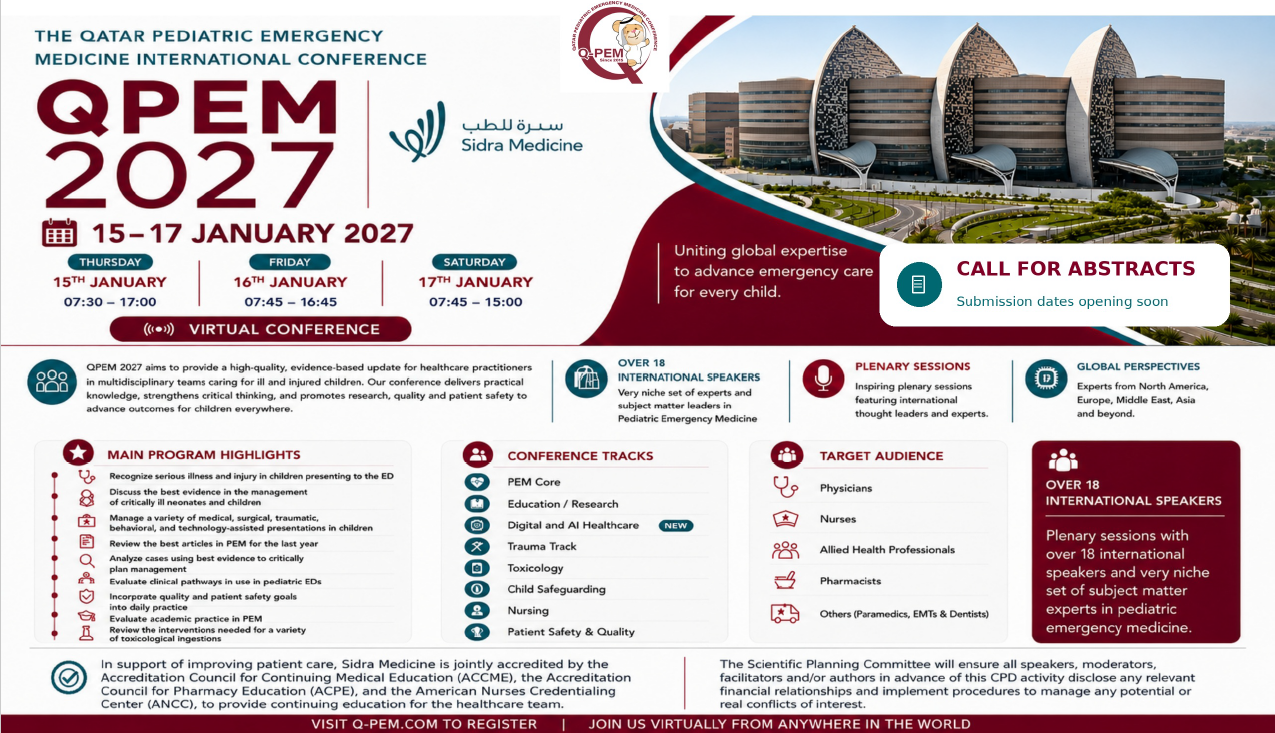
15 - 17 January 2027

CONTACT US:


+974 4003 1025

Sidra Medicine
Plaza Level, Office PB 200
Al Luqta Street
Education City, North Campus, Qatar Foundation
Doha, Qatar
WHO SHOULD ATTEND?
The 10th Qatar - Pediatric Emergency Medicine (QPEM) International online conference 2026 is open to the following target audience Physician, Nurse, Pharmacy, Allied Health Professional, Dentists, Others (Paramedics, EMTs, & Medical Students) with an interest in or practice involving providing emergency and urgent care to children.
“This activity is an Accredited (Category 1) as defined by the Ministry of Public Health’s Department of Healthcare Professions-Accreditation Section and is approved for a maximum of 20 hours”